




LEARN HOW TO LOAD UP, GET HITCHED, AND HIT THE ROAD

LOAD HEAVY CARGO FIRST
Safe and secure towing starts with loading your cargo correctly. Uneven trailer weight can lead to problems with steering, braking, and sway control.
Generally, 60% of your cargo weight should be loaded in the front half of your trailer and 40% in the rear half (unless otherwise directed by your trailer manufacturer). When loading cargo, you'll want to balance it evenly side-to-side, keeping the center of gravity low to the ground and over the trailer axle(s).
 | CORRECT: EVENLYLOADED TRAILERSafe and secure towing starts with loading your cargo correctly. Uneven trailer weight can lead to problems with steering, braking, and sway control. |
SECURE YOUR LOADAfter the cargo is properly balanced, you'll want to secure it in place. Unsecured cargo can shift while the vehicle is in motion, which can make your trailer unstable. Use nylon rope or towing straps to tie everything down. | INCORRECT: UNEVENTRAILER |

TYPES OF HITCHES AVAILABLE FOR RAM MODELS
RECEIVER HITCH
The most common of hitches usually used for boats or trailers up to 10,000 pounds.
 GO SLOW When towing a loaded trailer, it takes more distance to accelerate and brake. So take it slow and give yourself room between your truck and the other vehicles. Drive as you would on an icy road. | 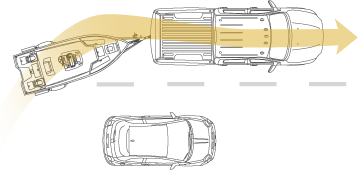 PASSING As a rule, only pass when necessary and obey all laws. Remember to account for your trailer length when passing a slower vehicle. Check that you've cleared the other vehicle before returning to your lane. Also, the extra trailer weight will make acceleration slower. Be sure to use your turn signals and allow for plenty of clearance. |
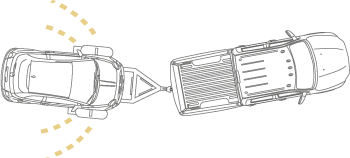 MAINTAIN CONTROL If you feel the trailer start to sway or whip, simply take your foot off the gas pedal. Do not brake or speed up. | 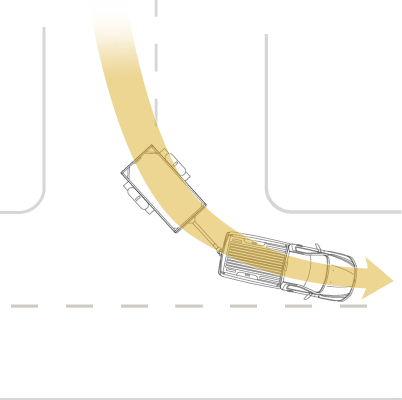 THE LONGER THE TRAILER, THE WIDER THE TURN Swing wide while turning and double check your mirrors to be sure your trailer clears all obstacles. |
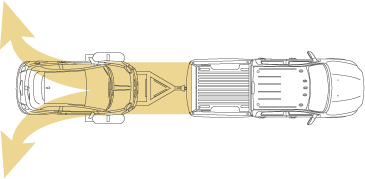 HOW TO BACK UP Start by putting your hand at the bottom of the steering wheel. To turn left, move your hand left. To turn right, move it right. Adjust your direction little by little. Slight turns of the steering wheel translate to greater movement of the trailer. If your trailer ends up jackknifing, simply pull forward to straighten out and try again. Backing up can take some getting used to so take it slow and have someone behind the trailer to spot you. | 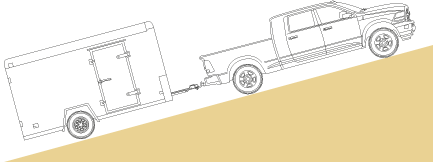 UNEVEN TERRAIN Always slow down before going downhill. If you're in a manual transmission vehicle, downshift when going both uphill and downhill. |

FEATURES TO MAKE TOWING EASIER
FOUR CORNER AIR SUSPENSION AVAILABLE
With the Active-Level Four Corner Air suspension with automatic load leveling, you can tow and haul with confidence. This also lowers the vehicle at highway speeds for reduced drag and greater efficiency.
TRAILER-TOW GROUP PACKAGEThe trailer brake controller operates the trailer's brakes so that it brakes in tandem with the vehicle's brakes. This system is electronic and fully integrated. The tow package also includes*: Class IV Receiver Hitch Power Trailer Tow Mirrors with Manual Fold-Away Exterior Mirrors with Courtesy Lights |  |
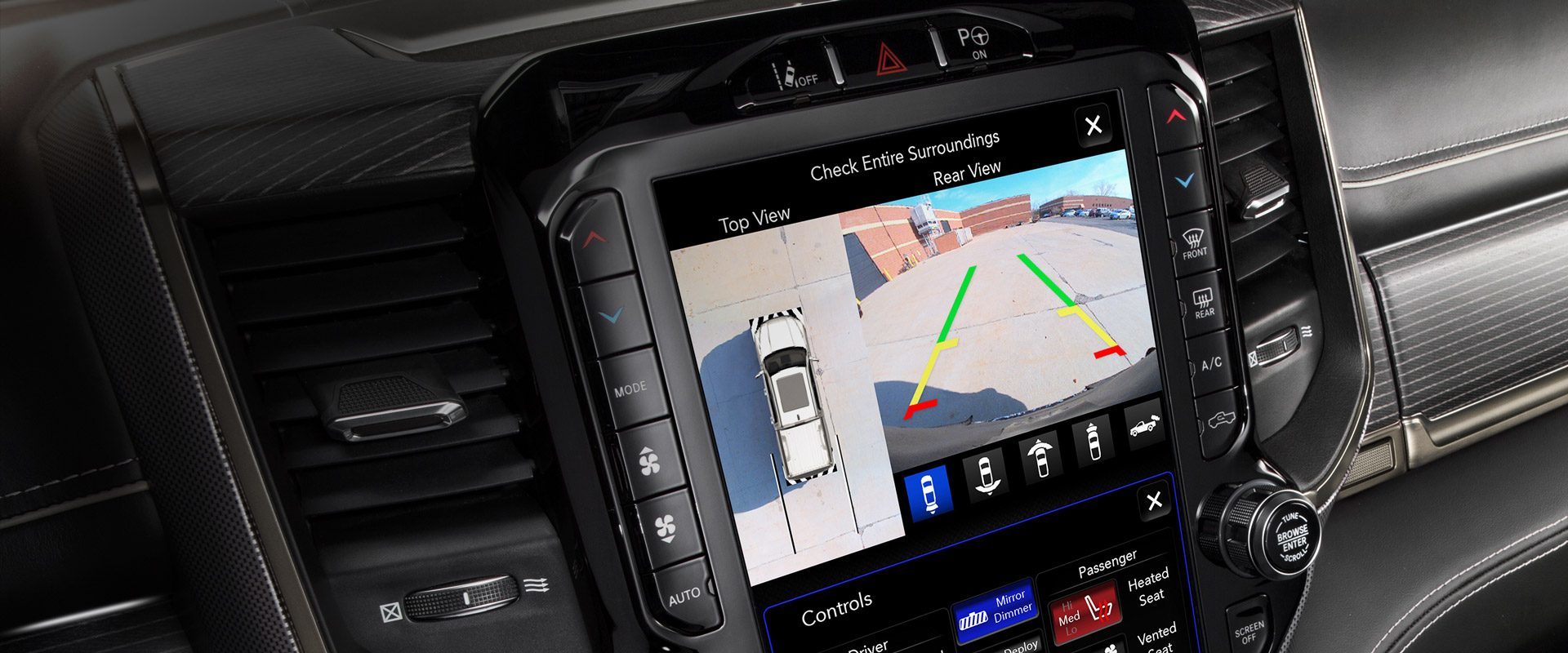 | SURROUND VIEW CAMERAProvides a complete 360 degree picture of vehicle surroundings** to help make things like parking, loading and unloading, and hooking up a trailer safer and easier. |
*See dealer for details
**Always check entire surroundings visually before proceeding.
TOWING GLOSSARY
Your one stop shop for all the lingo.
LIGHT DUTY TRUCK
Perfect combination of power and efficiency. Used for towing boats, ATVs, or trailers. A Ram 1500 can tackle these jobs.
HEAVY DUTY TRUCK
Usually used for towing construction equipment and other heavy commercial loads. Also great for R/Vs or horse trailers where you need extra capability. Look for the Ram 2500 and 3500.
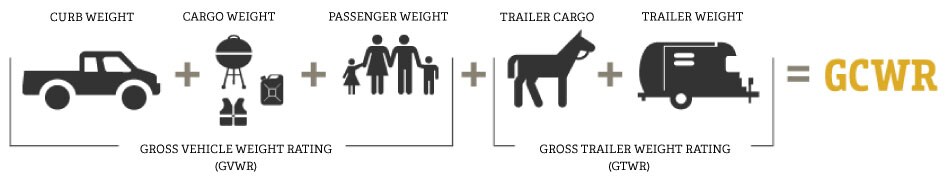
CURB WEIGHT
The weight of the vehicle without any passengers or cargo, but including all necessary fuel, fluids, and standard equipment.
CARGO WEIGHT
Total weight of all of your vehicle's cargo.
PASSENGER WEIGHT
Total weight of all of your passengers, given a driver weighing 150 pounds.
TRAILER CARGO
Total weight of all of your trailer's cargo.
TRAILER WEIGHT
Total weight of your trailer
GROSS VEHICLE WEIGHT RATING (GVWR)
The total weight of a fully loaded vehicle, including passengers and payload - but excluding all towing.
GROSS TRAILER WEIGHT RATING (GTWR)
The total weight of the trailer plus all the cargo in it.
GROSS COMBINED WEIGHT RATING (GCWR)
Assumes properly equipped vehicle and 150-pound allowance for driver. Additional options, equipment, passengers, and cargo weight must be subtracted.
PAYLOAD
The transported load, freight, EXCLUDING the weight of the trailer or tow vehicle.
TONGUE WEIGHT
The downward force exerted on the hitch ball by the trailer.
AXLE RATIO
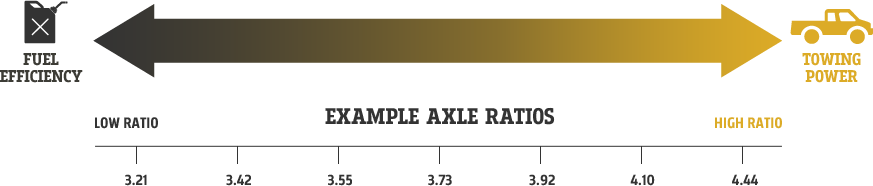
Gears in the truck's differential, which is a mechanical device that links the rear axle to the driveshaft and then the engine. Expressed as a ratio such as 3.55:1 meaning the drive shaft turns 3.55 times for every turn of a wheel.
A higher axle ratio offers more towing power and quicker acceleration, while a lower axle ratio offers better engine efficiency and quieter vehicle operation. Ram trucks come in a variety of axle ratios to suit your various towing needs. Find the balance of power and efficiency and view all the new Ram trucks here.
Find a Ram Truck for Your Towing Needs
Choosing the right truck for towing depends on the trailer, cargo, passengers, equipment, and vehicle configuration. Ram offers light-duty and heavy-duty truck options for a range of towing and hauling needs, from the Ram 1500 to the Ram 2500 and Ram 3500.
Explore the new Ram truck inventory at A. M. Maus and Son in Kimball, MN, to compare available trucks and configurations. For help finding a truck suited to what you plan to tow, contact our dealership and speak with our team.